A fabric softener that feels very slippery in a small-sample test is not necessarily suitable for real-world laundering. Towels need to retain absorbency; shirts are judged by wrinkle appearance and ease of ironing; synthetic fibers may be more sensitive to static in dry conditions. Raw-material screening should start by defining the condition the target fabric is expected to have after laundering.
Both hair-care conditioning and textile finishing require attention to friction, softness, and surface residue after treatment, but the target substrates and use processes differ. Published research has combined deposition tests for organomodified siloxanes with fabric hand-feel evaluation, offering a methodological reference for material screening.[1] This article discusses fabric-care evaluation using Quaternium-80 as a candidate raw material; equivalence between the material studied in the cited research and our own grade has not been established.
For products that already use a base softening system such as esterquats, Quaternium-80 can initially be positioned as a candidate performance-enhancing additive to determine whether it improves a clearly defined use attribute. Keep the base system as consistent as possible so the contribution of the added ingredient can be identified.
If the plan also involves reducing the dosage of the base softener, run a separate round of trials. Otherwise, reducing base ingredients and increasing the candidate additive at the same time makes it difficult to determine the cause of any change in feel. Demonstrating the enhancement first and then assessing formulation restructuring generally produces results that are easier to interpret.
From a materials-design perspective, deposition behavior of charged components and silicone-related surface feel can be evaluated separately.[1] Actual deposition, distribution, and post-treatment feel are still influenced by fiber type, formulation components, and the laundering process. The actual amount deposited on fabric cannot be inferred from the ingredient name alone.
Softness and slipperiness should also be distinguished. Fabric bending, loft, compression recovery, and surface friction all shape user perception. A sample that feels more slippery but also heavier may not fit the product positioning better than the original formula.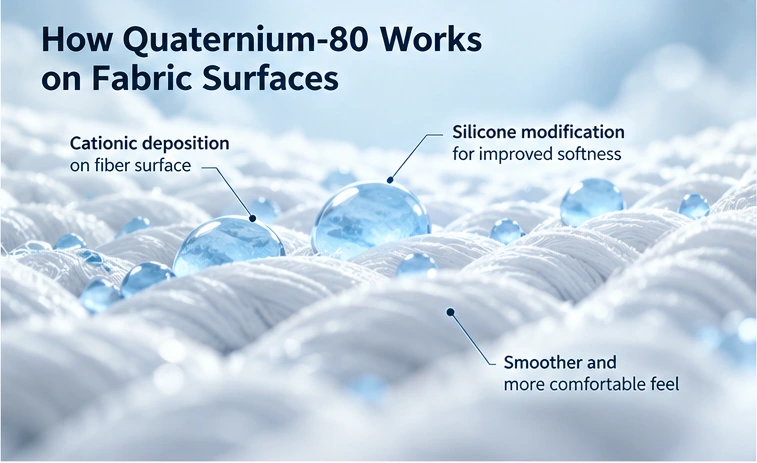
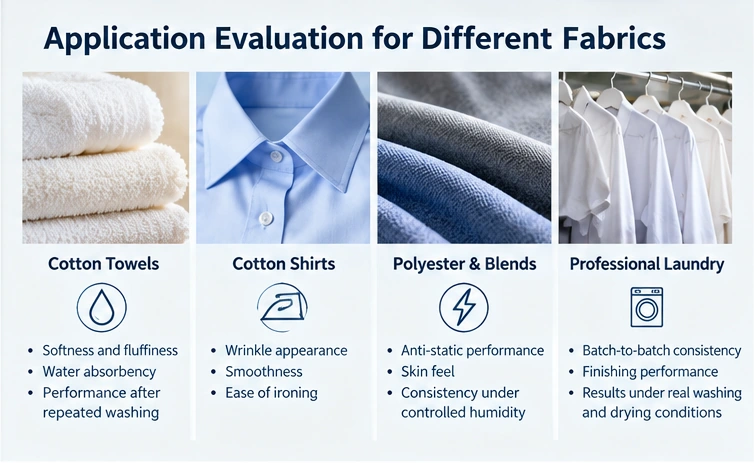
Select representative fabrics first, then determine the test matrix. Combining all fabrics into one average hand-feel score can conceal shortcomings on a particular fabric type.
|
Target Fabric or Scenario |
Primary Evaluation Criteria |
Additional Checks |
|
Cotton towels and bath towels |
Softness, loft, and user comfort |
Absorption rate and performance, including changes after repeated treatment |
|
Cotton shirts and bed sheets |
Wrinkle appearance, smooth feel, and ease of ironing |
Appearance, uniformity, and residue feel under identical finishing conditions |
|
Polyester and blended garments |
Static, next-to-skin feel, and surface hand |
Performance and repeatability after conditioning at agreed temperature and humidity |
|
Professional laundry processes |
Batch-to-batch consistency, finishing performance, and operational efficiency |
Results under actual rinse-water, equipment, drying, and ironing conditions |
Record softness, antistatic performance, and absorbency separately. Improvement in one attribute should not automatically be taken as evidence that the other two have improved. Studies of silicone softeners with different structures also evaluate hydrophilicity, softness, and durability separately.[2] For products with high absorbency requirements in particular, absorbency should be a formulation acceptance criterion, not an afterthought added only after hand-feel testing.
A raw material's compatibility in a concentrated fabric softener does not mean it will remain appropriately dispersed in rinse water. Formulation development should consider at least two environments: the product as stored on the shelf and the diluted solution actually used by consumers or laundry equipment.
At the concentrate stage, monitor appearance, viscosity, flowability, and changes during storage. At the point of use, assess dilution uniformity, flocculation, floating matter, and treatment uniformity on fabric. Test water should include water representative of the target market or the customer's site; evaluation should not stop after screening with deionized water alone.
Where residual anionic surfactants may be present, treat the residue level as a controllable test variable. Cationic and anionic components may interact, but interaction does not necessarily mean failure, nor does it mean every combination will remain stable. Evaluate the final formulation under actual dilution, mixing, and treatment conditions.
Fragrance, thickening systems, and electrolytes should also be included in later-stage verification. A candidate that is stable only in an unfragranced base liquid is not yet ready to be treated as a finished-product solution. Set the order of addition, pre-dilution method, and shear conditions according to the documentation for the specific grade, and keep them consistent in test records.
Screening fabric-care additives? Share your target fabric and primary improvement goal to discuss available Q80 grades and technical documentation.
The first round can include the base softener formulation, the current benchmark formulation, and low, medium, and high dosage levels of the candidate material. Use the same fabrics, wash loads, number of rinse cycles, and drying method for all groups, and make up the formulation to the same total amount as appropriate.
If suppliers provide comparable active-content data and test methods, include controls at equal active dosages. If comparison is possible only on an as-supplied basis, clearly record that limitation. Equal active dosage improves the fairness of the comparison but does not prove equivalent performance.
Use coded samples for hand-feel evaluation to reduce the influence of formulation names or expected effects on evaluators. Condition all fabrics consistently before comparison. Evaluators should use the same descriptors where possible, such as soft, smooth, lofty, heavy, and residue feel, rather than recording only “good” or “bad”.
Absorbency can be assessed using a laboratory-validated drop test, wicking test, or another suitable method. Static evaluation should specify the friction method and environmental conditions. Different methods answer different questions, so results should be compared using the same method under the same conditions. This article does not set a universal pass value for all fabrics.
After a single treatment passes, add repeated laundering cycles. Confirm whether the effect remains stable and whether repeated treatment causes absorbency, color, hand-feel, or appearance to deviate from the product target. A single test cannot replace evaluation under long-term use conditions.
The table below lists troubleshooting directions; it does not determine the cause of an issue with any specific grade.
|
Observed Issue |
Priority Checks |
How to Compare in the Next Round |
|
The concentrate is stable, but flocculation appears after dilution |
Water quality, residual detergent, dilution pathway, and local concentration |
Vary water and residue factors separately while holding other conditions constant |
|
Smoothness improves, but the fabric feels heavy |
Dosage level, base softening system, and drying conditions |
Reduce candidate dosage and compare again with the original base formulation |
|
Hand feel improves, but absorbency declines |
Fabric type, treatment intensity, and effects of repeated use |
Treat absorbency as a constraint and reassess dosage or candidate material |
|
Static results vary widely |
Conditioning, friction method, fabric batch, and number of repetitions |
Standardize evaluation conditions and check whether the difference is reproducible |
When adjusting a formulation, change one key variable at a time. Changing fragrance, viscosity, and raw-material dosage simultaneously in an attempt to improve hand feel often makes the next round of results harder to interpret.
Price comparisons should be based on the same laundry task. For example, compare costs per load or per kilogram of dry fabric when the same hand-feel, absorbency, and finishing requirements are met. Ranking raw materials by price per kilogram alone can overlook differences in actual dosage and adjustments to the base formulation.
For solutions claimed to reduce ironing time or improve drying efficiency, record the actual process using the same equipment and load conditions. Any relationship between a smoother fabric, fewer wrinkles, and time saved in operation should be supported by relevant process data.
It is recommended to evaluate it first as a candidate performance-enhancing additive while keeping the base system consistent. If the goal is to reduce base ingredients such as esterquats, run separate dosage-reduction and combination trials. Select the formulation based on target hand feel, absorbency, and formulation stability together.
Towels also need loft and absorbency. Record smoothness, softness, heaviness, and absorption rate separately, and check changes through repeated laundering. Defining acceptance criteria around the intended user experience is a better basis for formulation selection.
This depends on the specific raw material, residue level, water quality, and mixing conditions. Control anionic residue and water quality separately, observe the use bath and treatment uniformity on fabric, and then determine the applicable range.
[1] Charge and size matters—How to formulate organomodified silicones for textile applications, Colloids and Surfaces A, 2019, 560, 180–188.
[2] Effect of block copolymer silicone softener on textile fabric hydrophilicity, softness, and durability, Journal of the Indian Chemical Society, 2024.
If you are developing fabric softeners or professional laundry-finishing products, contact Cosmecrafts to discuss Q80 grades available, current technical documentation, and sample requirements. Please briefly describe the target fabric, base softening system, and the hand-feel, static, or absorbency attribute you most want to improve. The suitability and dosage of a specific grade must be confirmed through formulation and fabric testing.
Request Fabric-Care Information and Evaluation Samples
You can also email: donna@cosmecrafts.com.